Showing posts with label Physiology. Show all posts

Magnesium function
Magnesium is the fourth most common cation in the human body and the second most abundant intracellular cation in the human body. The human body contains approximately 24g (1000mmole) of magnesium and it is involved in many intracellular processes and is very essential for life. Metabolic irregularity or disturbance is associated with various abnormalities. The main sources of magnesium are vegetables, soybeans, nuts, whole grain cereals, eggs, and seafood. The minimum daily dietary magnesium intake to maintain magnesium balance in a normal person is about 240mg per day.

Magnesium functions – Co-factor and agitator of many enzymes

Magnesium plays an important role in the functions of more than 300 enzymes, Na+. K+ ATPase, hexokinase, choline esterase. It actively participates in many metabolic activities in the body. Magnesium helps to metabolize proteins, lipids, carbohydrates, and nucleic acid. Magnesium is also vital in regulating the cellular distribution of sodium and potassium through involvement in Na+, K+ ATPase.

Magnesium functions -Maintains irritability of the cells

Magnesium acts as an inhibitor to the central nervous system, neuromuscular and cardiac muscles. For neuromuscular irritability magnesium and calcium are synergic and for cardiac muscles they are the antagonist.

Magnesium functions – Maintains homeostasis of cells

Magnesium is an essential cofactor in correlative enzymes of DNA, cell cycle and apoptosis. In plasma, magnesium is important for maintaining DNA structure and veracity of DNA replication and activating DNA repairing including nucleotide excision repair, base excision repair, miss match repair, and microtubule assembly. 


The primary functions of the thyroid hormone basically include:
Functions of Thyroid Hormone
Heat Production
Increases oxygen consumption and BMK of targeted tissues, especially in liver, cardiac muscles and kidney

Protein Metabolism
Promote the synthesis of proteins and enzymes

Carbohydrate Metabolism
Elevates the glucose level in the blood

Fat Metabolism
Promotes oxidization of fatty acids and strengthen the effects of catecholamine and glycogen of lypolysis.

Effects on growth and development
Essential for mental and physical development in human, especially for the development of brain and bone tissues

Effects on CNS
Increases the effectiveness of permissive antigen and increase the excitability of CNS

Effects of Cardiovascular System

Increases heart rate, cardiac contractility, cardiac output and vasodilatation  

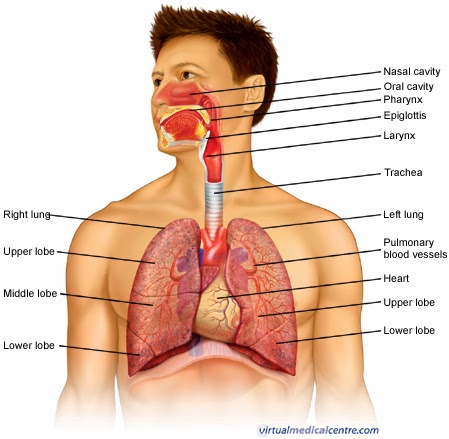
The main goals of the respiration are to provide oxygen to the tissues and to remove carbon dioxide. To achieve these goals, respiration can be divided into four major functions. They
  1. Pulmonary Ventilation. Means the inflow and out flow of air between the atmosphere and the lung alveoli.
  2. Diffusion, of oxygen and carbon dioxide between the alveoli and the blood
  3. Transport of oxygen and carbon dioxide in the blood and body fluids to and from the body’s tissue cell
  4. Regulation of ventilation and other focets of respiration
The upper airway consists of the nose, mouth, pharynx, and larynx. The larynx opens into the trachea, which in turn branches into two bronchi, enter into both lungs. The airway beyond larynx can be divided into two zones

Conducting zone
Extends from the top of the trachea to the beginning of the respiratory bronchioles

Functions
Provide low resistance pathway for air flow
Defends against microbes, toxic chemicals, and other foreign matters

Respiratory Zone
Extend from the respiratory bronchioles to the alveoli and is the region where gases exchange with blood. The inner surface of the airway down to the end of the respiratory bronchioles contains cilia, glands and epithelial cells, secrets mucus which keep the lungs clear of particulate matter and bacteria that enters body with dust particles. Another protective mechanism against infection is provided by the macrophages that exist in the airway and alveoli, these macrophages engulf and destroy inhaled particles and bacteria that have reached alveoli.


Reference 
Guyton, A & Hall, J. (2006).Text book of Medical Physiology.11th Edition. Elsevier Saunders 

The electrocardiogram (ECG or EKG) is primarily a tool for evaluating the electrical events within the heart. The action potentials of cardiac muscle cells can be viewed as batteries that cause charge to move throughout the body fluids. These moving charges currents, in other words – are caused by all the action potentials occurring simultaneously in many individual myocardial cells and can be detected by recording electrodes at the surface of the skin.

In a typical ECG , the first deflection is called the P wave. It corresponds to current flows during atrial depolarization. It generates about 0.2 mv and lasts for 0.1s

The second deflection, the QRS complex, occurs approximately 0.15s later. It is the result of ventricular depolarization. It is a complex deflection because the paths taken by the wave of depolarization through the thick ventricular walls differ from instant to instant, and the current generated in the body fluids change direction accordingly.

electrocardiogram

The S-T interval represents the time during which the entire ventricular muscle is depolarized.

The final deflection, the T wave , is the result of ventricular repolarization. Atrial repolarization is usually not evident on the ECG because it occurs at the same time as the QRS complex.A typical ECG makes use of multiple combinations of recording locations on the limbs and the chest (called ECG leads).

It is not a direct record of the changes in membrane potential across individual cardiac muscle cells. Instead it is a measure of the currents generated in the extracellular fluid 


The cardiac cycle is divided into into systole (ventricular contraction) and diastole(ventricula relaxation). At an average heart rateof 72 beats /minute, each cardiac cycle lasts approximately 0.8s , with 0.3s in systole and 0.5s in diastole.

1.     At the onset of systole, ventricular pressure rapidly exceeds atrial pressure, and the atrioventricular valves close. The aortic and the pulmonary valves are not yet open, however, and so no ejection occurs during this isovolumetric ventricular contraction(constant volume of blood in ventricle).
2.     When ventricular pressures exceed aortic and pulmonary trunk pressures, the aortic and pulmonary valves open, and ventricular ejection of blood occurs. The volume of blood ejected from each ventricle during systole is termed the Stroke Volume.
3.     When the ventricles relax at the beginning of diastole, the ventricular pressures fall significantly below those in the aorta and pulmonary trunk , and the aortic and pulmonary valves close. Because the atrioventricular valves are also still closed, no change in ventricular volume occurs during this isovolumetic ventricular relaxation.
4.     When ventricular pressures fall below the pressures in the right and the left atria, the Atrioventricular valves open, and the ventricular fillinf phase of diastole begins.
5.     Filling occurs very rapidly at first so that atrial contraction , which occurs at the very end of diastole, adds only a small amount of additional blood to the ventricles.
6.     The amount of blood in the ventricles just before systole is the end-diastolic volume. The volume remaining after ejection is the end-systolic volume, and the volume ejected is the stroke volume
Cardiac Cycle


The SA node is the normal pacemaker for the entire heart. Its depolarization normally generates the action potential that leads to depolarization of all other cardiac muscle cells, and so its discharge rate determines the heart rate, the number of times the heart contracts per minute.

The action potential initiated in the SA node spreads throughout the myocardium, passing from cell to cell by way of gap junctions. The spread throughout the right atrium and from the right atrium to the left atrium does not depend on fibers of the conducting system. The conduction through atrial muscle cells is rapid enough that the two atria are depolarized and contract at essentially the same time.

In the ventricles


Heart beat coordinationThe spread of the action potential to the ventricles is more complicated and involves the rest of the conducting system. The link between atrial depolarization and ventricular depolarization is a portion of the conducting system called the atrioventricular node, located at the base of right atrium. The action potential spreading through the muscle cells of the right atrium causes depolarization of the AV node.

After leaving AV node, the impulses enters the wall – the interventricular septum – between two ventricles.    This pathway has conducting-system fibers termed the bundle of His.

Within the interventricular septum the bundle of His divides into right and left bundle branches, which eventually leave the septum to enter walls of both ventricles. These fibers in turn make contact with Purkinje fibers, large conducting cells that rapidly distribute the impulse throughout much of the ventricles. 

Finally , the Purkinje fibers make contact with ventricular myocardial cells , by which the impulse spreads through the rest of the ventricles. The rapid conduction along Purkinje fibers and diffuse distribution of these fibers causes depolarization of all right and left ventricular cells more or less simultaneously and ensure a single contraction.


The circulatory system contains a pump (the heart) , a set of connected tubes (blood vessels or vascular system), and a mixture of extracellular fluid and cells (the blood) that fills them. This body-wide transport system is often termed as cardiovascular system.

Anatomy of heart

·        Muscular organ enclosed in pericardium and closely affixed by epicardium.

·        Cells of the walls of the heart is made of cardiac muscle cells called myocardium. Inner surface of chamber covered by thin layer of cells called endothelium.


·        Has four chambers – two atrium and two ventricles. Atroventricular valves are located between the atrium and ventricles. These valves allow blood to flow from atrium to ventricle. Right AV valve is called tricuspid valve. Left AV  valve is called bicuspid valve.

·        To prevent AV valves from being pushed up into atrium , the valves are fastened to muscular projections (papillary muscles) of the ventricular walls by fibrous strands(chordae tendinae).


·        Opening of right ventricle into pulmonary trunk and the left ventricle into the aorta also contains valves, Pulmonary and Aortic valves respectively. (also called semi-lunar valves). These valves allow blood to flow into arteries during ventricular contraction but prevent blood from moving in opposite direction during ventricular relaxation.

·        There are no valves at the entrances of the superior and inferior venae cavae into the right atrium, and of the pulmonary veins into the left atrium.

Cardiac muscle

·        Arranged in layers that are tightly bound together and completely encircle the blood-filled chambers.

·        Cells are striated – result of an arrangement of thick myosin and thin actin filaments


·        Cardiac muscle cells are shorter than skeletal muscle fibers

·        Adjacent cells are joined end to end at structures called intercalated discs. Adjacent to the intercalated discs are gap junctions.


·        1 percent of cardiac cells have specialized feature that are essential for normal heart excitation. These cells constitute a network known as conducting system of the heart and are in contact with cardiac muscle cells via gap junctions.


Innervation

·        The heart receives a rich supply of sympathetic and parasympathetic nerve fibers, the latter contained in the vagus nerves.

Blood supply

cardiovascular system·        The arteries supplying the myocardium are the coronary arteries, and the blood flowing through them is termed the coronary blood flow. The coronary arteries exit from the very first part of the aorta and lead to a branching network of small arteries, arterioles, capillaries, venules, and veins similar to those in other organs. Most of the coronary veins drain into a single large vein , the coronary sinus, which empties into right atrium.